.jpg) Like many late baby boomers, I spent a portion of my childhood fantasticated with the “space race” and the country’s focus on getting to the moon. I watched as many of the rocket launches as possible. I kept statistics on the astronauts, launch vehicles, and related technology like other boys kept on their favorite sports. I have memories of being allowed to stay up past my bedtime so that I could watch the broadcast of Neil Armstrong being the first human to step on the moon. Two months later, my family drove to Wapakoneta, Ohio to watch the homecoming parade for their hometown hero. As an adult, I have learned just how frenzied the effort was since the Soviet Union was the first country to land an unmanned craft on the moon, to have a man in space, and to conduct a spacewalk.
Like many late baby boomers, I spent a portion of my childhood fantasticated with the “space race” and the country’s focus on getting to the moon. I watched as many of the rocket launches as possible. I kept statistics on the astronauts, launch vehicles, and related technology like other boys kept on their favorite sports. I have memories of being allowed to stay up past my bedtime so that I could watch the broadcast of Neil Armstrong being the first human to step on the moon. Two months later, my family drove to Wapakoneta, Ohio to watch the homecoming parade for their hometown hero. As an adult, I have learned just how frenzied the effort was since the Soviet Union was the first country to land an unmanned craft on the moon, to have a man in space, and to conduct a spacewalk.
An integral part of my youthful wonder was the images of earth from space. Somehow those images started the transformation of the globe – an abstract representation of planet – into a place filled with people who have the same daily needs as me. The Bette Midler song, From a Distance, captures this concept better than I can. I still get memorized by images from space. Some of the recent ones have been auroras recorded from the International Space Station, a Japanese weather satellite capturing the moving shadow of a solar eclipse, and the volcanic activity on the island of Hawaiʻi.
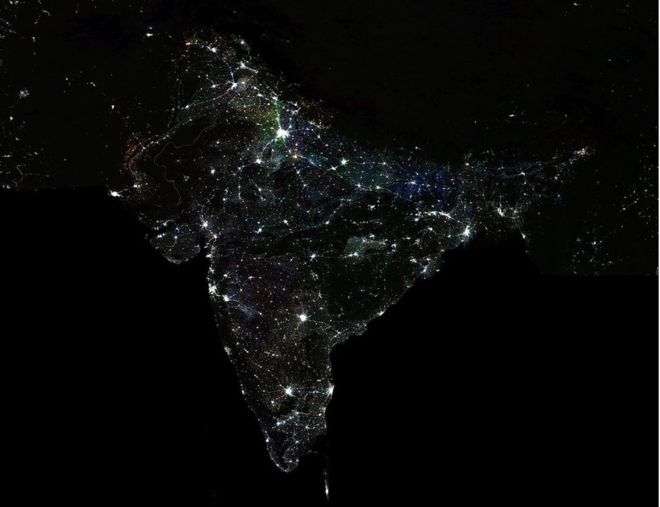 Just as I have learned how the US had been losing the space race, I have started seeing image of earth that challenge the sameness from a distance. The most recent was a BBC story on the regional economic inequality in India being visible from space. By superimposing images taken at night, the little amount economic activity in much of India becomes apparent from the lack of light.
In his presentation, David Simmer talks about the advantages that most of us have because with live in the First World. This became crystal clear for me when I overheard a Target employee and customer talking about what color temperature and luminosity of LED bulb to purchase. 42% of Wisconsin households are living on the edge of financial insecurity and have a wide range of lighting options while large sections of India go with little or no light at night. With the time, talent, and treasure of my 1,221,977 fellow Rotarians, I can be part of making a difference in these disparities though the Six Areas of Focus. I can strive to view the reality of the differences and inequalities around world while holding to the vision of our sameness.
One should, for example, be able to see that things are hopeless and yet be determined to make them otherwise. – F. Scott Fitzgerald