.jpg)
It was my first undergraduate management course that I first encountered Maslow’s Hierarchy of Needs. Abraham Maslow first described this pattern of human motivation in a paper that he wrote in 1943 and later refined in his 1954 book. This hierarchy is often depicted as a pyramid with our basic needs at the base and self-actualization – reaching one's full potential – at the top. According to Maslow’s theory, a person cannot reach his/her full potential unless the deficiency needs are met. Additionally, a person needs to satisfy the lower needs before s/he can find success in addressing the higher-level needs. As presented in the course, helping employees satisfy these needs is powerful motivation.
The theory made a lot of sense to me. As a self-funded college student, I often found myself on the edge financial security – safety (level 2). That created problems in developing interpersonal relationships and my esteem. Later in my career, my health would bring me down to bottom where my physiological needs were not being met and I would have to rebuild my pyramid. I found reinforcement of this theory in articles where Maslow’s Hierarchy being used to describe the behavior of individuals, groups, and organizations. Maslow had become my hammer, so all my problems where nails.
Thankfully, Rotary became a place where I found that I could satisfy need for social belonging (level 3). Rotary was the catalyst to germinate the seed that had been planted when I travelled to France as teenager to help build a house for the director of a Christian camp. In those weeks in the Summer of 1977, I got to know other American teenagers as well as French villagers. I got a glimpse that we had similar wants and fears. Rotary has helped me to fully understand that each person is more alike than different regardless of faith traditions, political philosophies, and skin tones. As a RYE host parent, I have felt the special joys of a student reaching the conclusion that “different is different” is a fact and not a value judgement.
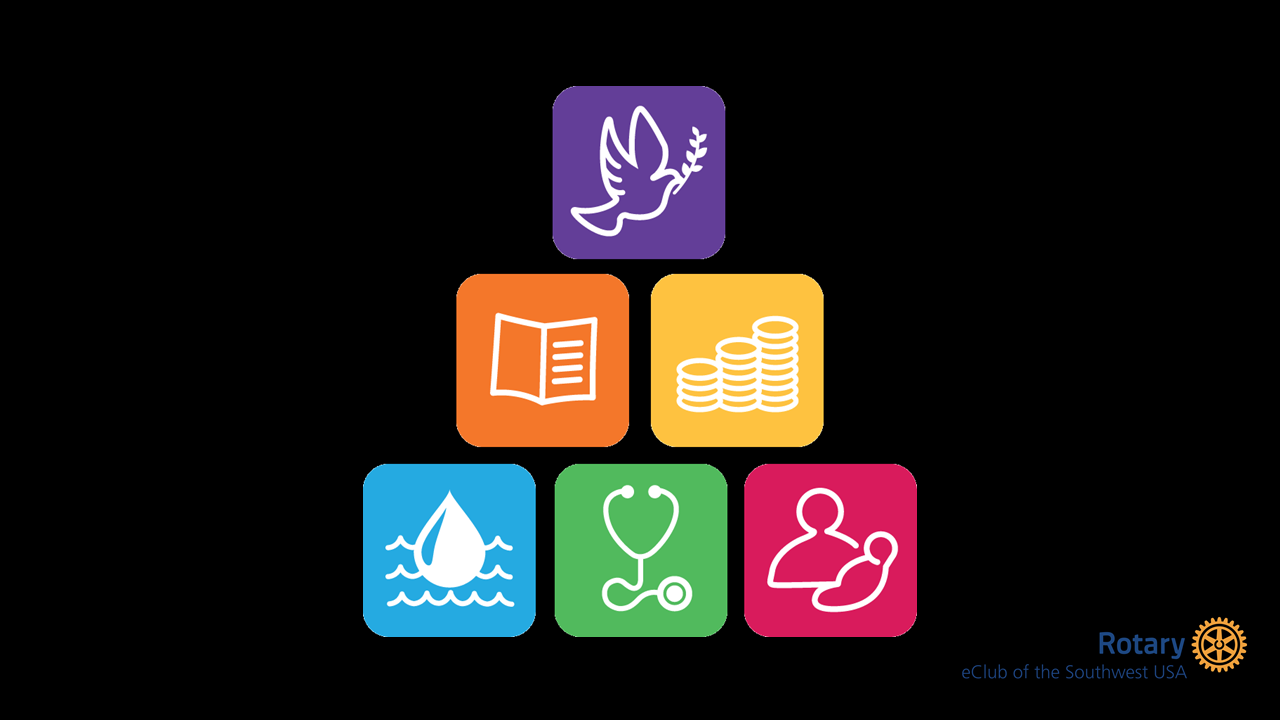
Because of Rotary, I no longer look at problems through the lens of Maslow’s Hierarchy. Rotary’s theme for February is Peace and Conflict Prevention/Resolution Month. When placing Rotary’s Six Areas of Focus into a pyramid, Peace is at the top. As our program speaker, Summer Lewis, describes, conflict arises from unmet needs. I believe that a key to understanding and meeting those needs is through personal understanding found in looking for similarities not differences. Television writer/producer Norman Lear was once asked if he had a bumper sticker, what would my bumper sticker be? His reply was, “Just another version of you.” Through Rotary I can become the best version of myself in service to other versions of me.